PRESBYTERY
The earliest part of the church is the Gothic presbytery with tall windows, dating to the first half of the fourteenth century, though its present-day appearance results from a Gothic Revival restoration. The 1901 project by Josef Seyfrieda (1865–1923), which included the radical replacement of the original vaulting of the choir with a new Neo-Gothic vault, was executed in the following year. The architect embellished the vault with stucco ribs, applied cylindrical buttresses with foliate capitals to the walls, and added blind arcading with pointed arches. The choir’s remodeling was completed by historicizing ornamental interior painting executed in 1903 by Hans Martin (1853–1919) of Munich (repainted in 1954 and completely whitewashed in 1976).
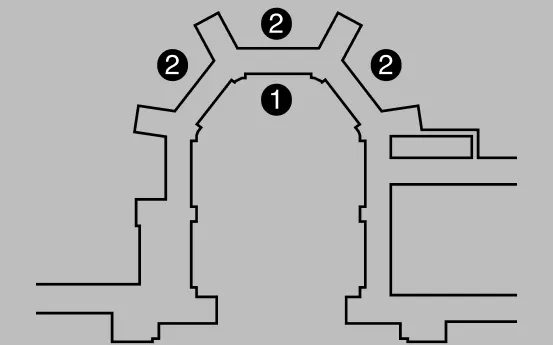
High Altar of St John the Baptist (1)
Salomon Steinhoffer (workshop) – Wood – 1660s
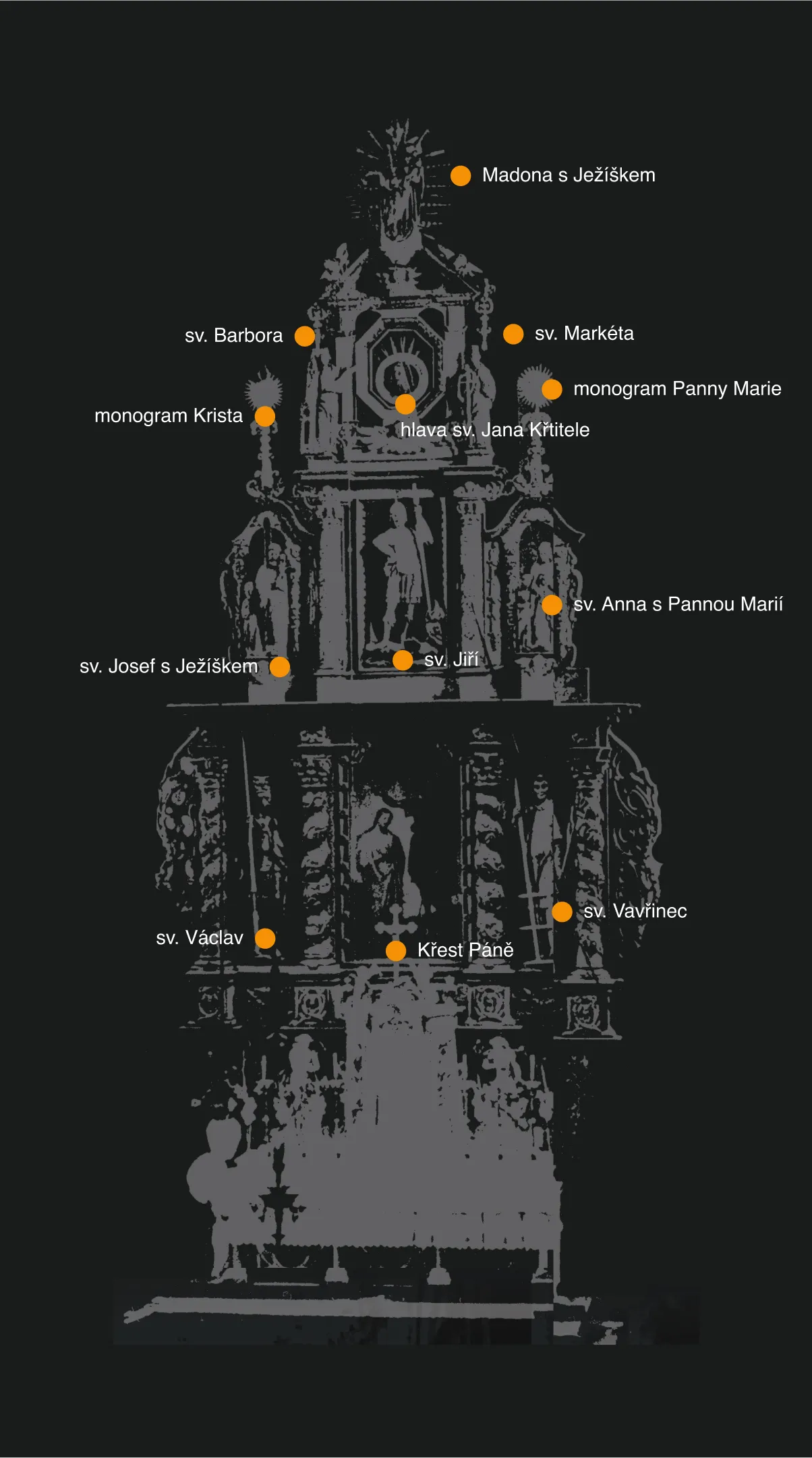
The artistically most valuable monument of the church interior is the early Baroque high altar. It was commissioned by the Counts of Gaschin from Gaschin, owners of the Hlučín estate between 1629 and 1727. They were members of the traditional Catholic nobility and loyal supporters of the Habsburgs. Jan Jiří Gaschin (died 1657) married for the second time in 1640 Anna Maria von Oppersdorf (1623–1663), through whom a direct connection can be traced to the altar’s creator, the Silesian sculptor Salomon Steinhoffer (died 1665), who worked for extended periods in the service of the Oppersdorf family.
This is an exemplary example of an early Baroque Catholic altarpiece. It consists of a massive retable with a pyramidal composition divided by columns into several stories, furnished with niches for statues and a central altarpiece. A characteristic period feature is the so-called auricular ornament decorating the edges and crowns of the altar’s architectural elements. It derives its name from the similarity to the shapes of cartilage and bone structures of the human body.
The altarpiece painting depicting the Baptism of Christ refers to the dedication of the church to St John the Baptist. The original canvas was replaced around 1880 by a new painting by Jan Bochenko (1831–1909). The retable’s architecture is adorned with a large number of saint figures. On either side of the altarpiece are figures of the territorial patron St Wenceslas and St Lawrence, who was then venerated as patron of the town of Hlučín, which was afflicted by numerous fires. Higher up, in the center, stands the statue of St George with the slain dragon (together with the Baptist, patron of Jan Jiří Gaschin), flanked by St Joseph with the Christ Child and St Anne with the Virgin Mary as a young maiden (patroness of Anna Maria von Oppersdorf). In the altar superstructure is another reference to the church’s dedication: the severed head of St John the Baptist in a bowl with a halo. On either side are figures of virgin saints, St Barbara with her tower and St Margaret with her sword. Crowning the entire structure on the split pediment stands the Madonna with the Christ Child, clothed in a blue mantle strewn with golden stars. She stands upon a crescent moon, symbol of purity, and is adorned with regalia—crown and scepter. The Christ Child holds an apple and blesses with his right hand.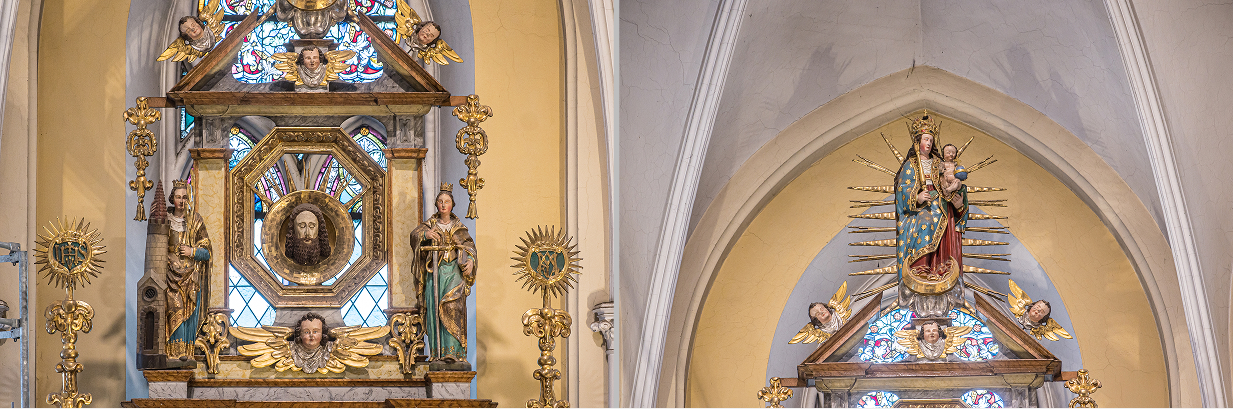
The altar features a marble Neo-Gothic altar table dating from 1905, the work of Opava stonemason Wilhelm Drechsler (1865–1919), who also created a Neo-Gothic tabernacle. However, the tabernacle was stylistically incompatible with the altar, and so it was donated to the church in Přívoz in 1922. Its place was taken by an original late Baroque tabernacle adorned with figures of adoring angels, dating from the end of the eighteenth century (allegedly 1790).
It should be noted that the Gaschin family subsequently collaborated extensively with the Steinhoffer workshop. In this engagement, the sculptor created his most significant work: the high altar and choir stalls for the Marian church in Ratibor (1653–1660), as well as an altar and crucifix for the Dominican church of St James, where the Gaschin family had their private chapel. The mortal remains of both Jan Jiří and Anna Maria were laid to rest in the family tomb there.
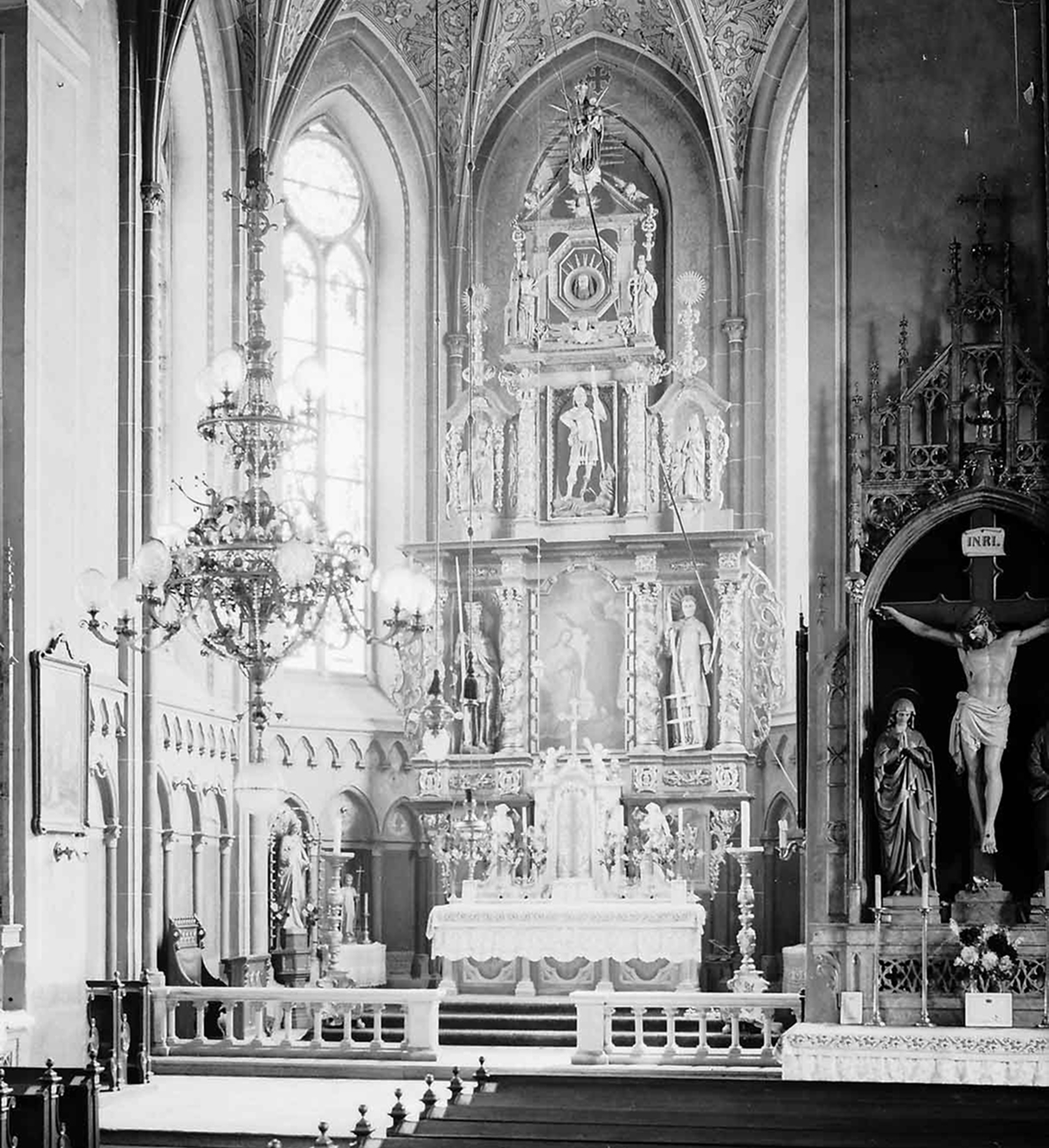 Pohled do kněžiště, dobová fotografie, 30. léta 20. století.
Stained Glass Windows (2)
Emmanuel Lazar – Painted glass – 1902–1904
Concurrent with the remodeling of the choir, new stained glass windows were commissioned from the art studio of Emmanuel Lazar of Ratibor. Hlučín pharmacist Cesar Heisler donated the left figurative stained glass window depicting the Holy Family. On the opposite side is a window showing the Virgin Mary with her parents, St Joachim and St Anne. The windows with a so-called carpet ornament pattern were financed by parishioners from villages belonging to the parish (Bobrovníky, Rovniny, Vřesina, and Darkovičky).