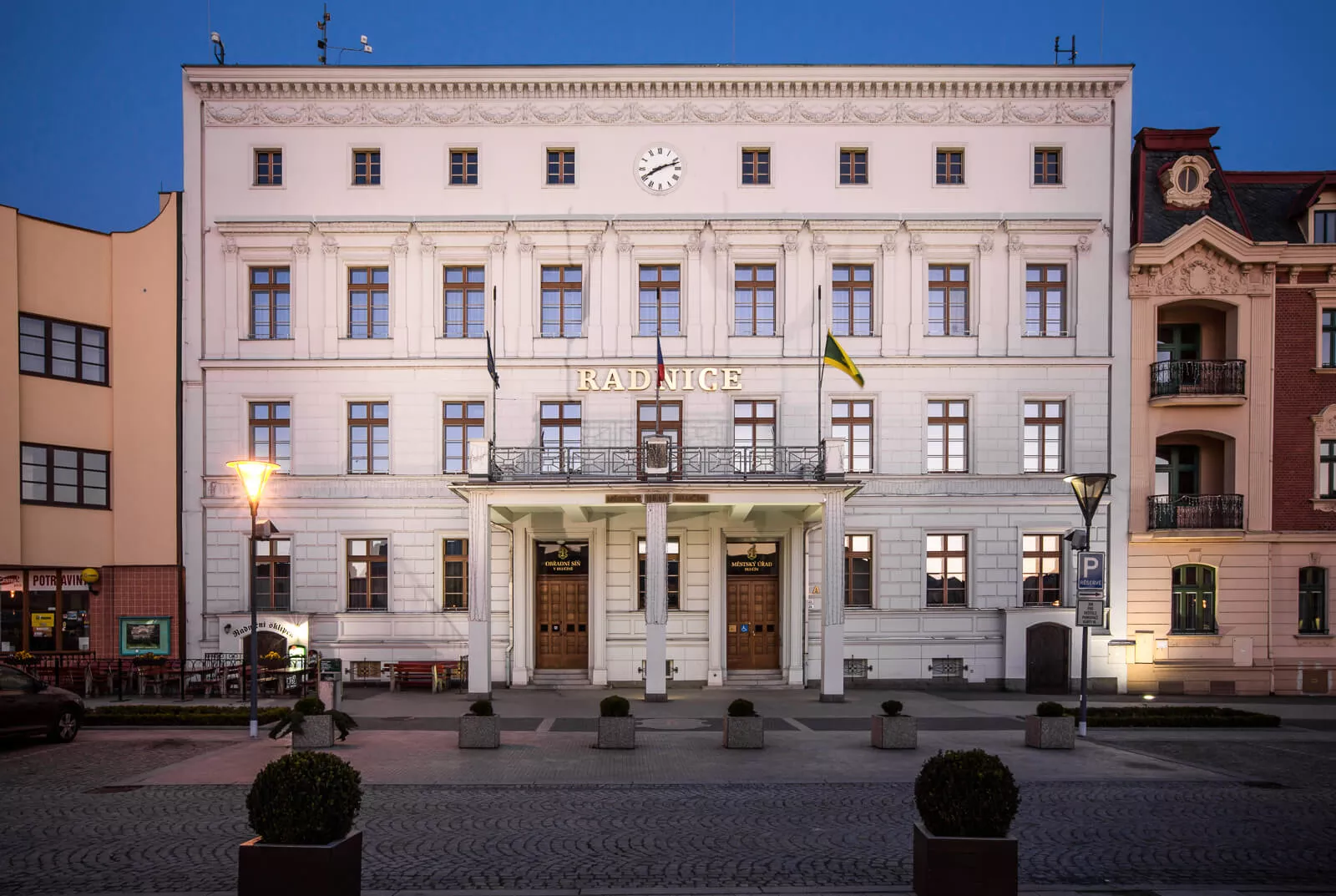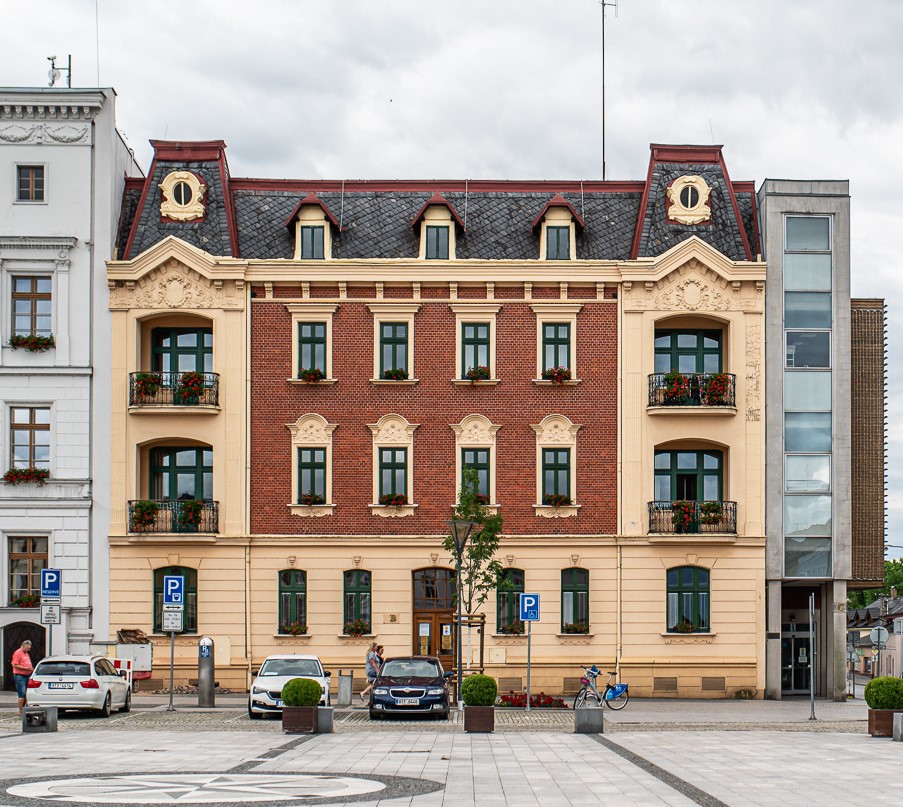
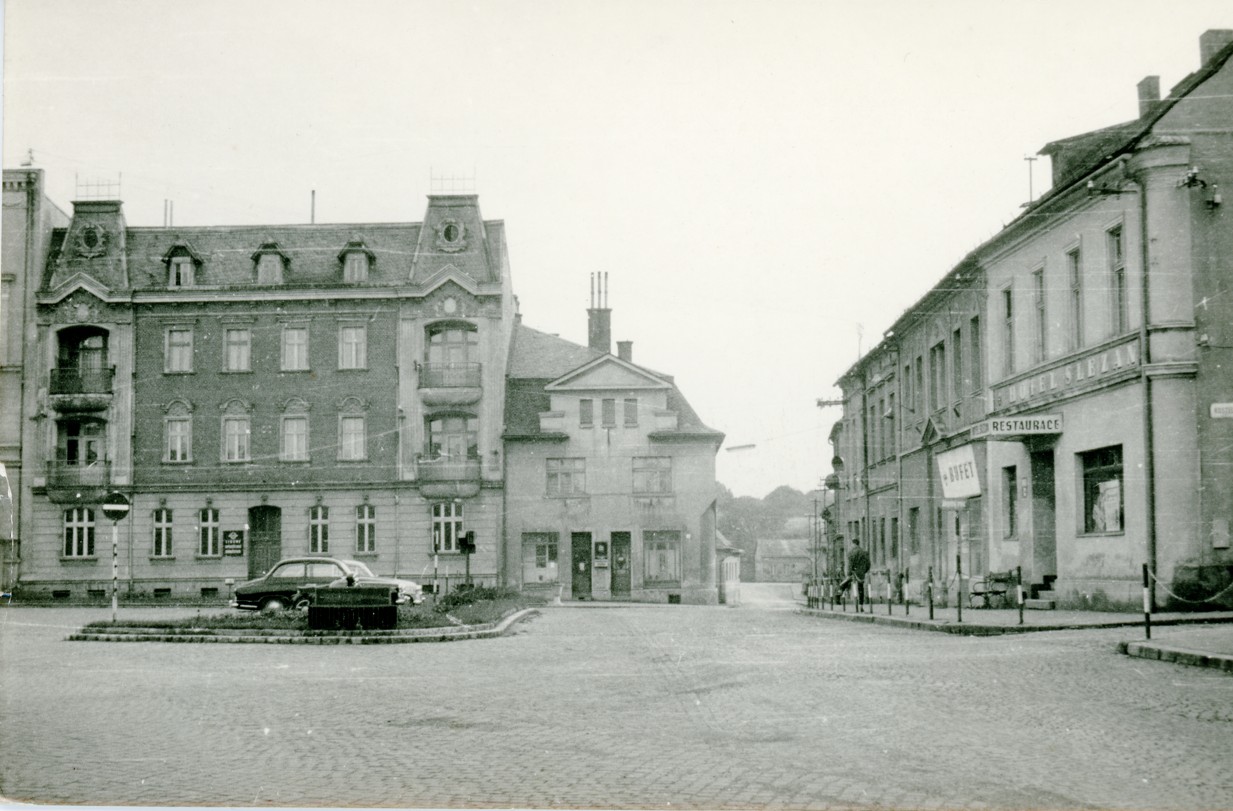
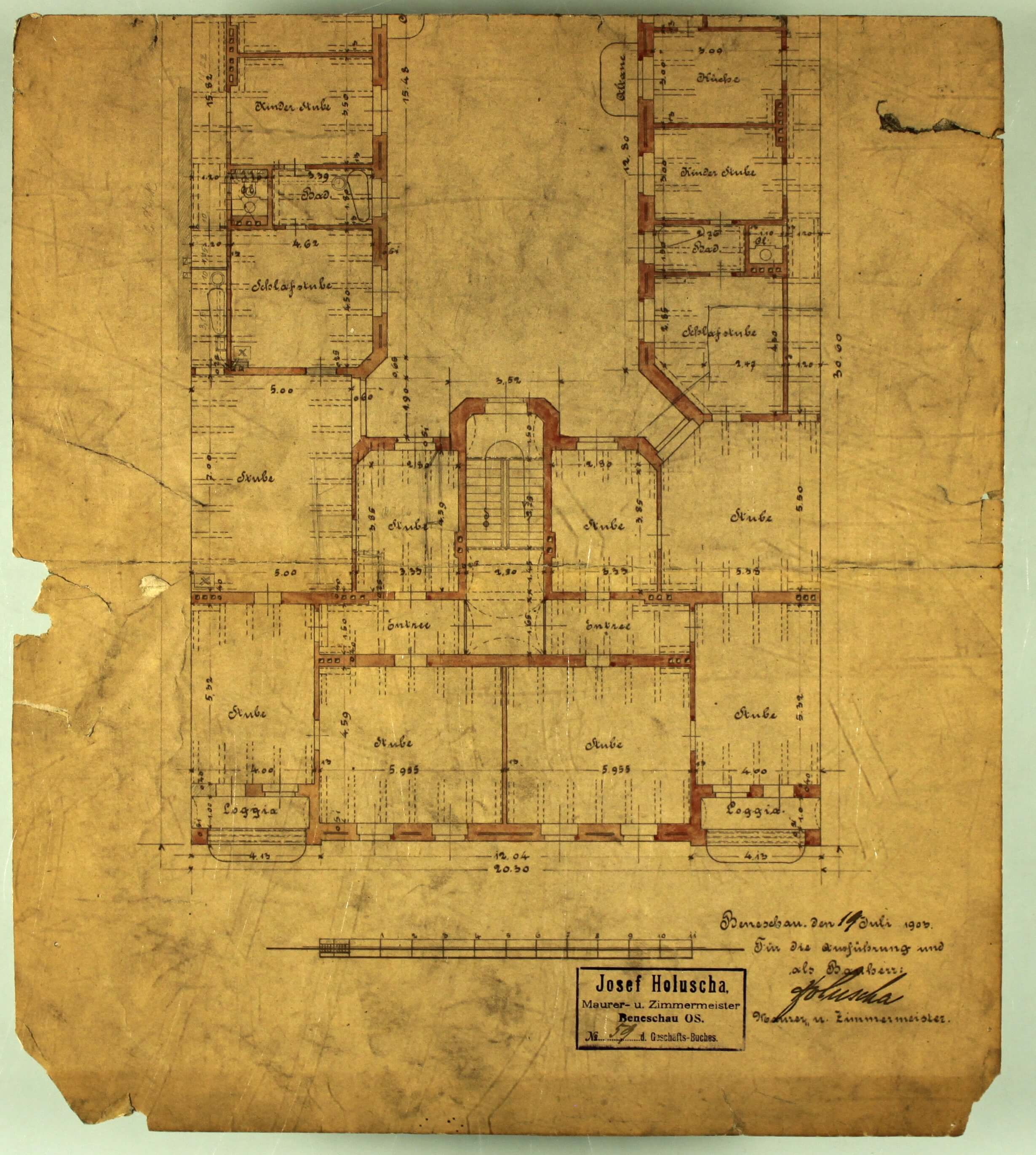
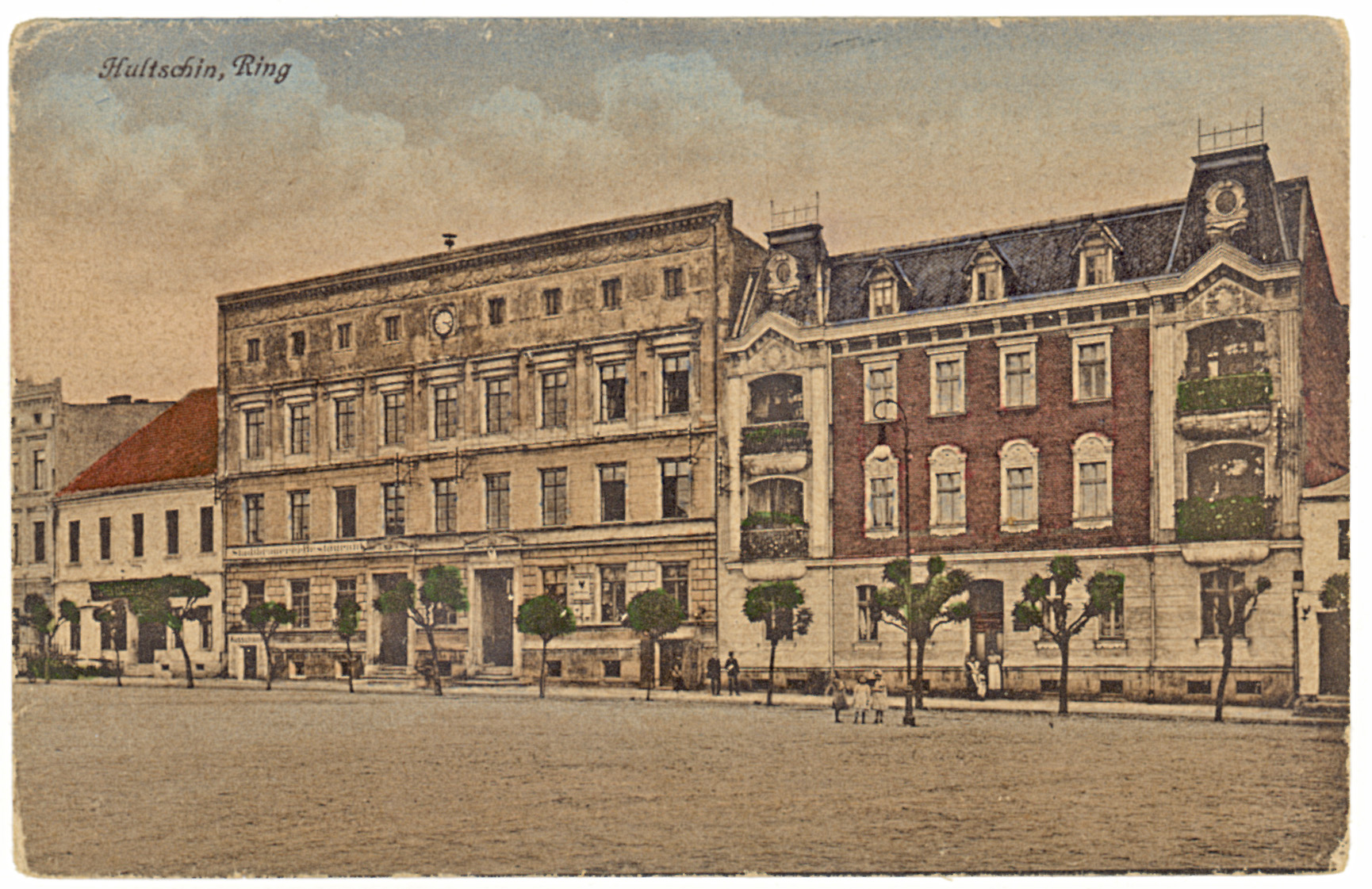
The most imposing residential building on Hlučín’s square was commissioned in 1903 by the grain wholesaler Czerny. It is a three-storey apartment building built on the site of two earlier dwellings beside the town hall. It is not known who authored its façade, which is unusually designed for Hlučín. Surviving documentation bears the signature of builder Josef Holuscha (1865–1927) from Dolní Benešov, though the demanding and atypical design of the façade makes it unlikely to be his own work; he was probably responsible only for the floor plan.
The broad six-bay façade with a central entrance is framed on each side by shallow corner projections adorned with tall orders of fluted pilasters and balcony niches on the first and second floors. The central four-bay section is of exposed brickwork, sharply contrasted by moulded stucco window surrounds. On the first floor, the windows are embellished with Baroque-inspired pediments featuring Art Nouveau floral motifs, while those of the upper floor are topped by a simple cornice. The main moulded cornice breaks at the projections to form triangular pediments containing stucco shields with scrollwork ornamentation. Rising above these projections are conically tapering roofs inspired by the French architectural tradition, each with oval Baroque-shaped dormers. The roof ridge was originally crowned with a metal cresting.
In the interwar period, the ground-floor premises housed the Silesian Trading Cooperative and the Moravian Agrarian and Industrial Bank. Among the residents were Karl Hill (1886–?), the bank’s chief cashier from Poruba, and Dr Wilhelm Greef (1884–?), an Evangelical from Göttingen who had served as director of the local hospital since 1912. His flat was subsequently occupied by another hospital director, Anton Zwinger. After 1945, the building was taken over by state authorities and the police, who remain based here today.