CHAPEL OF THE HOLY ANGELS
The Chapel of the Three Kings, which was later rededicated to the Holy Angels, was attached to the south side of the church, presumably in the fifteenth century. It is covered with a ribbed vault spanning two bays.
Side Altars and Paintings
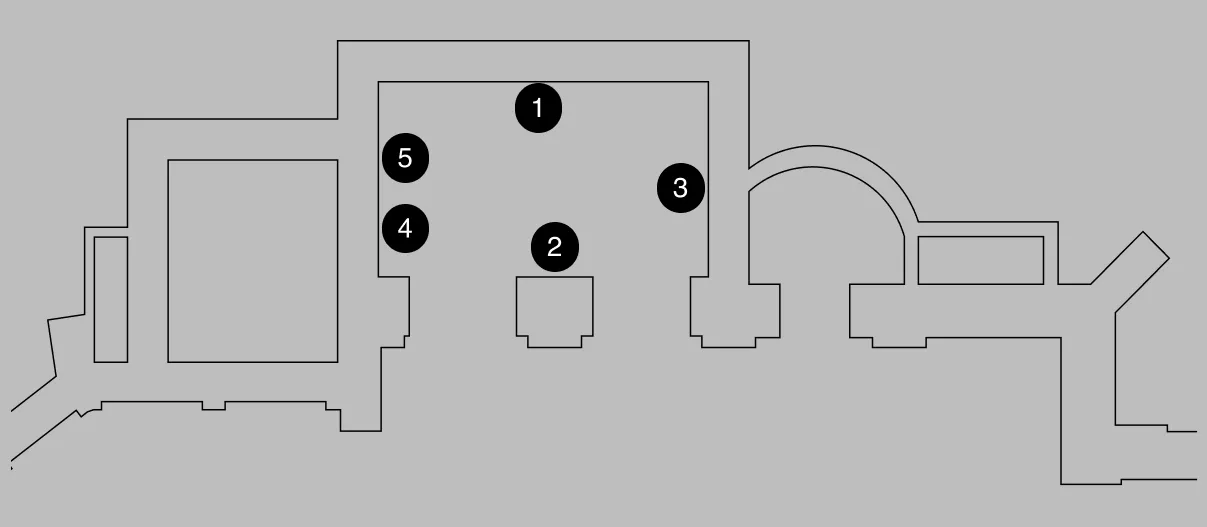
Altar of St Barbara (1)
Author unknown – Wood – Second half of the seventeenth century
The early Baroque altar with a columnar retable, embellished with so-called auricular ornament, originates from the same period and workshop as the altar in the Chapel of St Anne. Here too, its original decoration has not survived in its entirety. The original elements include the figures of St Francis of Assisi and his contemporary St Clare (who originally held a crozier as the abbess’s insignia and a monstrance in her right hand), as well as a modest painting in the upper section of the altar depicting the Holy Family en route to Jerusalem (the Virgin Mary, the twelve-year-old Jesus, and St Joseph under the protection of the Holy Spirit). The original main altarpiece has not been preserved. Around 1880 it was replaced by a canvas by Jan Bochenek (1831–1909) depicting St Barbara.
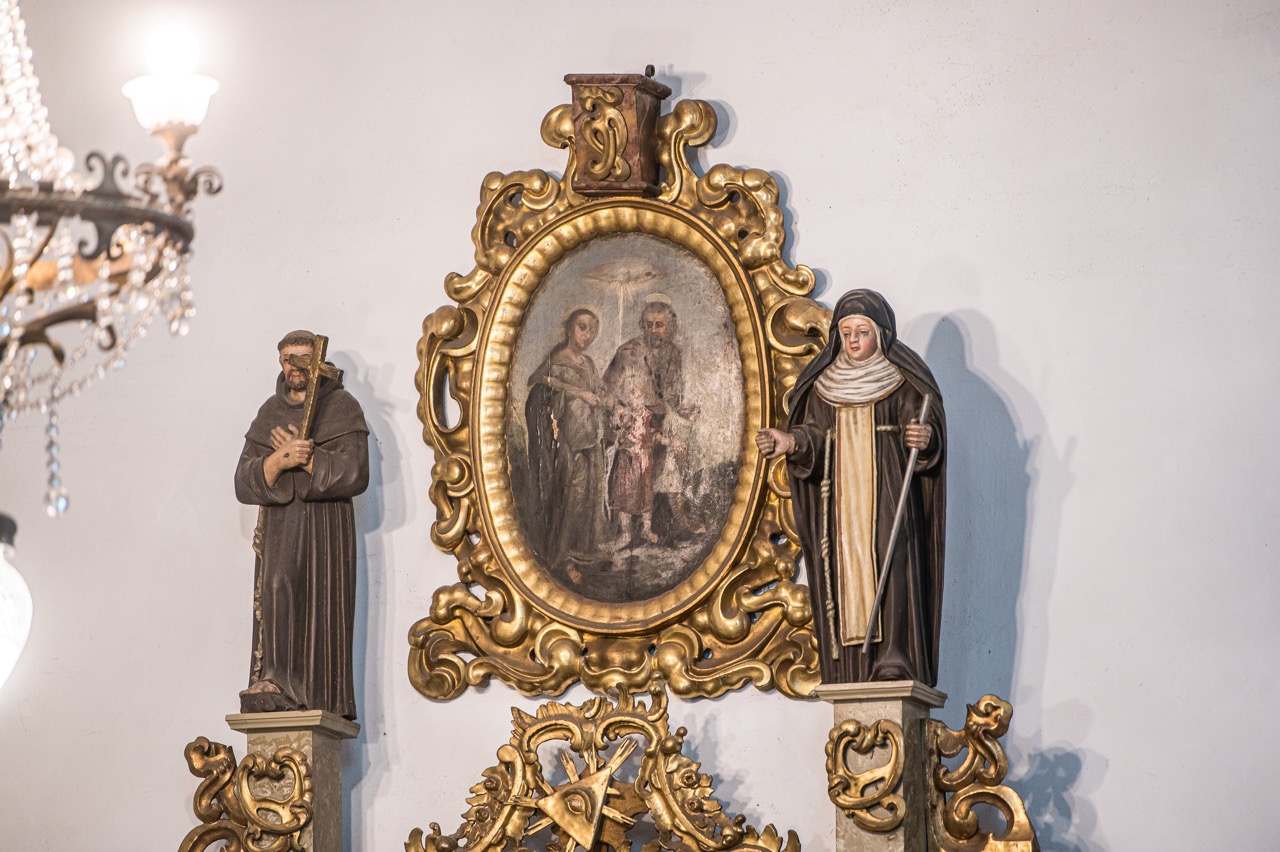 St Anne with the Virgin Mary and the Christ Child Oil on canvas, late seventeenth century
Painting of the Guardian Angel (2)
unknown – Oil on canvas – 1770s or 1780s
The artist here reinterprets the Old Testament narrative of Tobias accompanied by the Archangel Raphael, adapting it to convey a more universal message concerning divine protection through a guardian angel. A man garbed as a pilgrim is led by the hand of a larger-than-life angelic figure and, sheltered beneath his protection, walks trustingly through a world beset by snares and sin, represented here by a serpent spewing infernal fire. With his right hand, the angel points toward the upper portion of the composition, where the divine name is inscribed in Hebrew. This serves as a symbol of divine certainty and an eternal source of refuge.
Painting of Christ Falling Under the Cross (3)
Author unknown – Oil on canvas – 1770s or 1780s
This is the only surviving painting from a late Baroque Way of the Cross, originally mounted on frames furnished with inscriptions in the Moravian language. Given its poor condition and incompleteness, during the reconstruction of the interior in 1920, it was decided to commission a new Way of the Cross. This was purchased in 1923 in Munich from the art studio of Josef Müller (1872–1935; Kunstanstalten Josef Müller).
Altar of Our Lady of the Rosary (4)
Jan Baltazar Janda – Wood – 1874
The Neo-Gothic altar originates from the workshop of the Berlin sculptor Jan Baltazar Janda (1827–1895), a native of Darkovičky. It is adorned with a relief depicting the Rosary Madonna, in which the Virgin Mary with the Christ Child is shown in heavenly glory presenting the rosary to the kneeling St Dominic. To the right stands St Catherine of Siena, deeply absorbed in prayer, with a wreath of roses at her feet. Janda had created an identical relief shortly before for the Church of St Paul at the Dominican monastery in Berlin-Moabit (1872–1873). While in Berlin the frame was decorated with fifteen scenes representing the Mysteries of the Rosary, in Hlučín the relief is set within a Neo-Gothic architectural framework, in the gable of which is added a relief of the blessing God the Father and a dove representing the Holy Spirit.
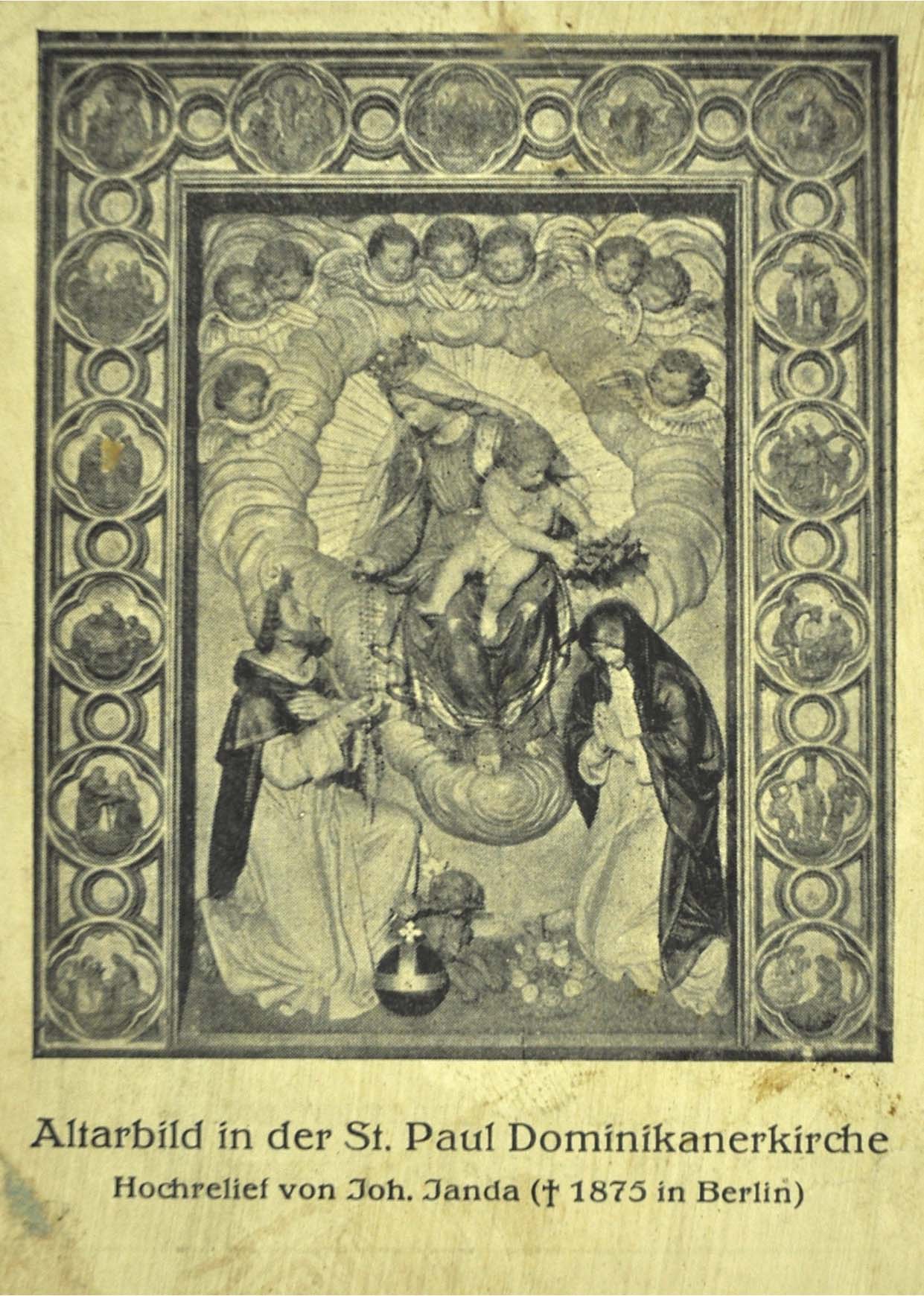 Relief of the Rosary Madonna by J. Janda in the Church of St Paul in Berlin-Moabit, period photograph, condition before 1945
Tomb
Memorial Tombstone of the Male Members of the Bruntál Family from Vrbna
Author unknown – Sandstone – 1625
In 1625, merely one year after his elevation to the rank of count, Václav Bruntál from Vrbna (died 1649) had two stone memorial plaques installed in the church (originally positioned on either side of the high altar) dedicated to the deceased members of his family. One was intended to commemorate the paternal line descending from his father John from Vrbna (died 1592), while the other commemorated the maternal line through his mother Marusha Tvorkovská from Kravař (died 1625). Both stone plaques still existed in the first half of the twentieth century; however, in 1922, Marusha’s plaque was broken and destroyed during its transportation from the church exterior to the interior. We know of it only through a single photograph.
The preserved plaque, now secondarily positioned in the Chapel of the Holy Angels, bears a text panel bordered by an arrangement of family coats of arms associated with the paternal Bruntál line. Their coat of arms crowns the plaque at the top center, while on either side we recognize the arms of families into which the Bruntál family married (from Fulstein, Žerotín, Šternberk, Krajek, Nasile, Pernstein, Kravař, Ludanice, and Nová Cerekev). The inscription, composed by Václav Bruntál, reads in translation:
To God, the Best and the Highest (D.O.M.).
To the Exalted, Noble, Renowned, and Free Lords from Vrbna and Bruntál—to Stephen the grandfather, to John, our most beloved father, Imperial Majesty’s councilors, captains of the Duchy of Opava, lords of Hlučín, to Matthew and Stephen, our beloved brothers, and to the greater number of our cousins, who rest here in God. Peace to their dust. Václav, by the grace of the Holy Roman Empire Count of Vrbna and Bruntál, Lord of Hlučín, Fulnek, Paskovy, and Zábřeh, Imperial Privy Councilor and Chamberlain, on the 31st of May, 1625.
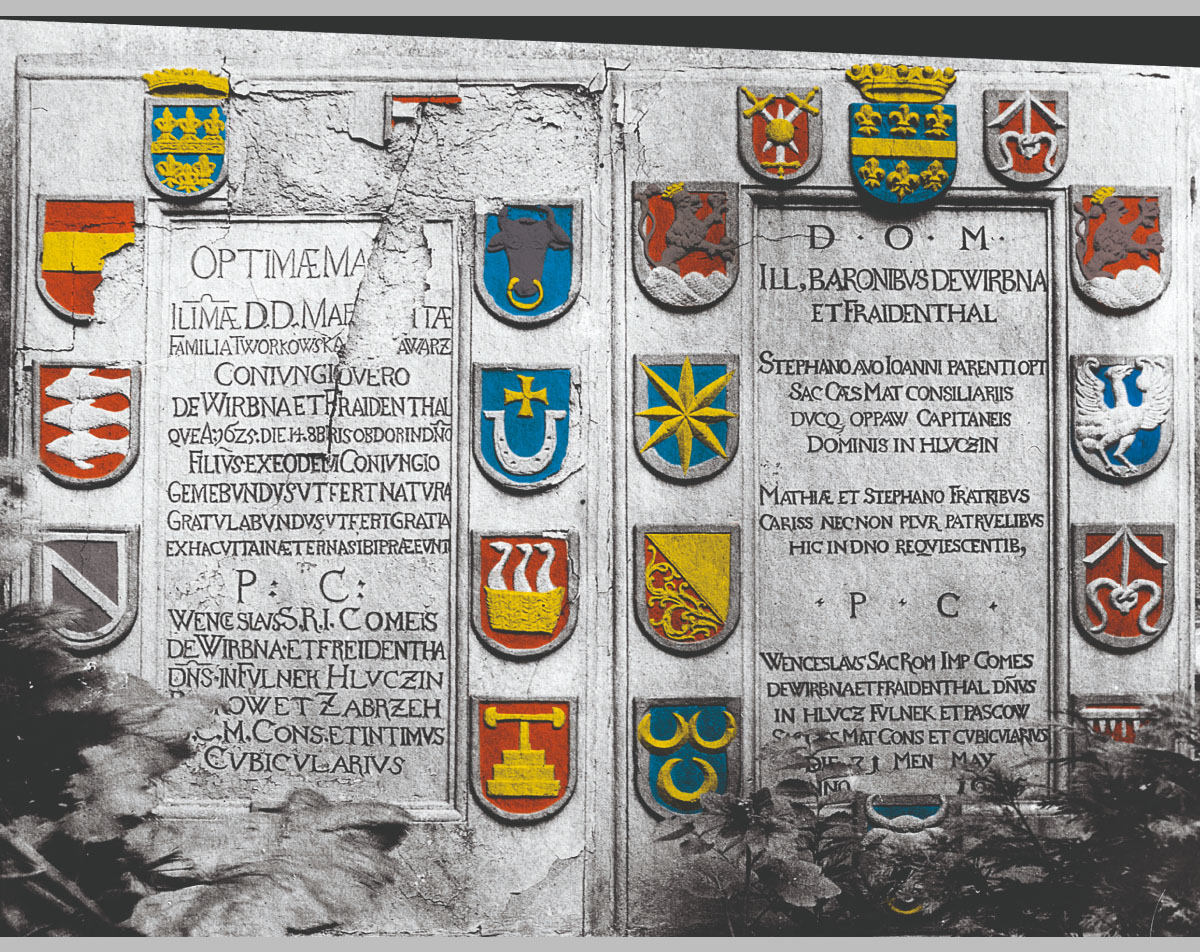 Pair of Memorial Epitaphs at the time of their placement on the church exterior. The tombstone of Marusha Tvorkovská (left) did not survive; the plaque on the right belongs to the Bruntáls from Vrbna. Period photograph, condition before 1922, with color reconstruction of the heraldic arms.