STRUCTURAL DEVELOPMENT
The founding and location of Hlučín are connected with the figure of the Czech king Premysl II Otakar, and although historical literature traditionally gives 1256 as the year of the town’s foundation, it is more probable that it should be dated to the 1270s.
It may be assumed that a parish church was also established upon the town’s founding. If this occurred, an older sacred building might have been utilized, or a simple temporary wooden church was erected. We have definite evidence of the existence of a parish church only from a charter dated 1378, in which the dukes of Opava, Václav and Přemek, granted permission to the brothers Peter and Kunesh of Varta, owners of a court near the town of Hlučín, to donate six copies of groschen toward the construction of a new side altar dedicated to Corpus Christi. Here the text already refers to the present church.
The construction of a brick-built, oriented Gothic church most probably began during the first half of the fourteenth century, apparently on the site of an earlier, modest structure. Its location set apart from the town square in proximity to the fortifications is characteristic of the High Middle Ages. Despite numerous later modifications, particularly the exterior has retained the appearance of a Gothic church with pointed windows and buttress piers. The polygonally closed chancel, with its slender pointed windows and buttress piers running along its exterior, is notably tall. It remains uncertain whether the church space was from the outset a single-naved structure vaulted with four bays of ribbed vaulting. Given the width of the nave, a three-aisled design is also possible, perhaps executed as a pseudo-basilica with an elevated central nave and lower side aisles. This interpretation would be supported by the height of the Gothic windows in the nave, which rise only to half the level of the walls. On the axis of the main façade stood a stone tower, which, however, collapsed at the end of the sixteenth century.
Presumably in the fifteenth century, a Chapel of the Three Kings (later rededicated to the Holy Angels) was attached from the south side, vaulted with two bays of ribbed vaulting. During the sixteenth century, opposite chapels were added: the Chapel of St Anne (1508), and behind the Chapel of the Three Kings, in 1522, a modest chapel with a polygonal closure dedicated to Archangel Michael, together with a corresponding chapel of St Mary of Egypt on the opposite side (today the north entrance of the church). The Chapel of St Anne was remodeled to its present form only at the end of the sixteenth century—evidenced by the use of Florentine or caparison-style corbels beneath the ribbed vaults. A catastrophe occurred in 1597 when the church tower collapsed, destroying part of the nave and demolishing the vaults. The church subsequently remained without a tower for nearly two hundred years. Shortly after restoration, in 1616, the church was damaged by fire, and another collapse of the vaults ensued.
The present appearance of the Church of St John the Baptist is marked by pronounced Baroque modifications dating from the seventeenth and eighteenth centuries. The current vaulting, consisting of a barrel vault with lunettes, dates from 1618, when apparently the breaking through of smaller oval windows above the Gothic ones also took place. The exterior and interior underwent a great transformation around 1791, when a new tower was constructed, furnished with late Baroque, nearly Neoclassical ornament. At the same time, an artistic unification of the church’s interior nave occurred, articulated by a pair of fluted pilasters of high order supporting a continuous molded cornice.
In 1901, Rector Hugo Stanke (1861–1921) undertook a re-Gothicization of the choir, which was worked out according to his specifications by Joseph Seyfried (1865–1923) in 1901. The project, which involved the radical replacement of the original vaulting of the choir with a new Neo-Gothic vault, was executed in the following year. The vault was furnished with stucco ribs, cylindrical buttresses with foliate capitals were applied to the walls, and blind arcading with pointed arches was added. In subsequent years, Stanke still considered further building modifications that would facilitate the church’s operation and eliminate unsuitable temporary structures; however, projects by Joseph Seyfried (1912) as well as by other Prussian architects Max Giemsa of Katowice (1914) and Hans Schlicht of Wroclaw (1916) were never executed. Partial restorations of the church’s interior and exterior in later years did not significantly alter its original appearance.
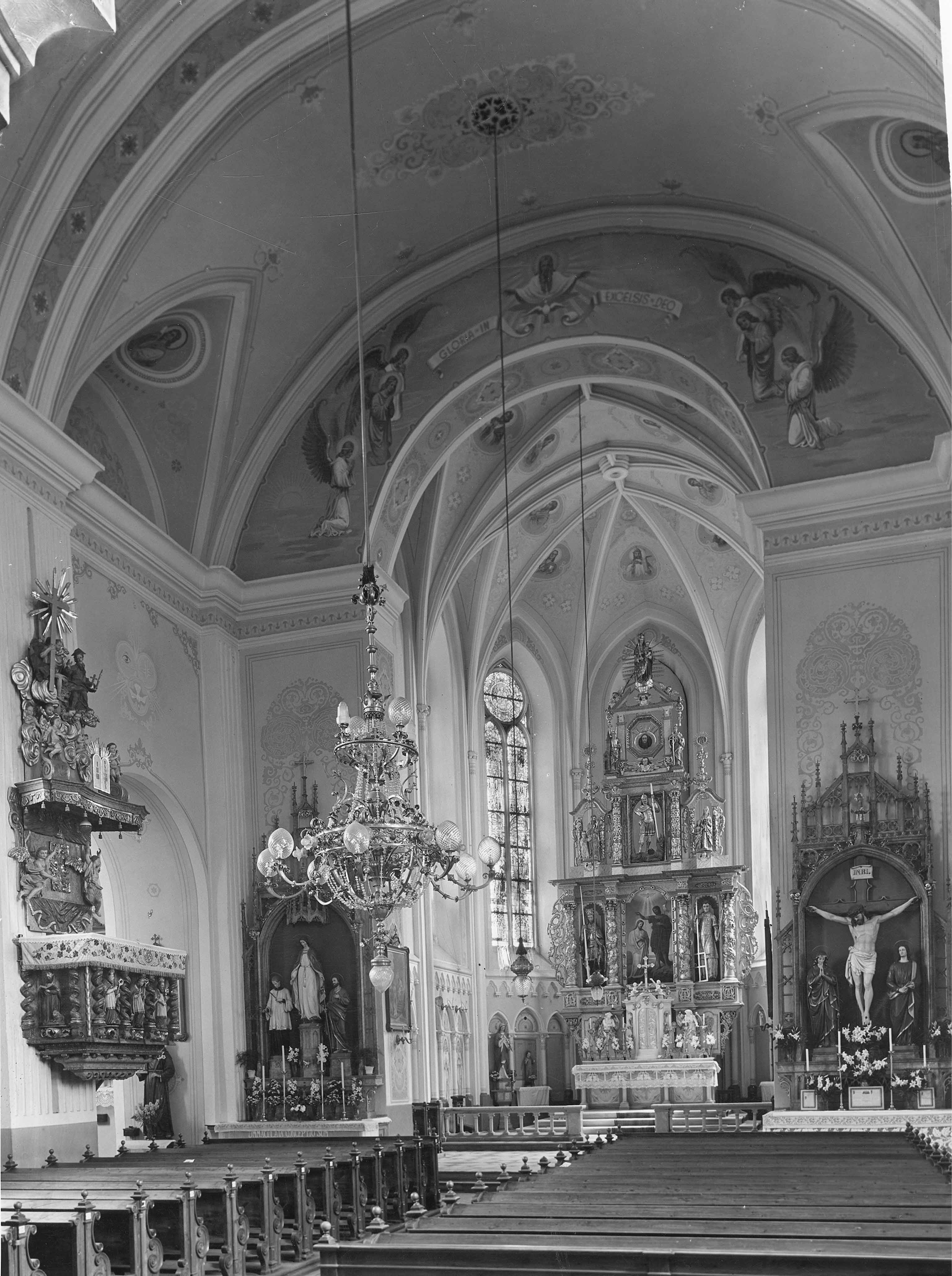 View of the Church Nave toward the Choir, Period Photograph, 1960s
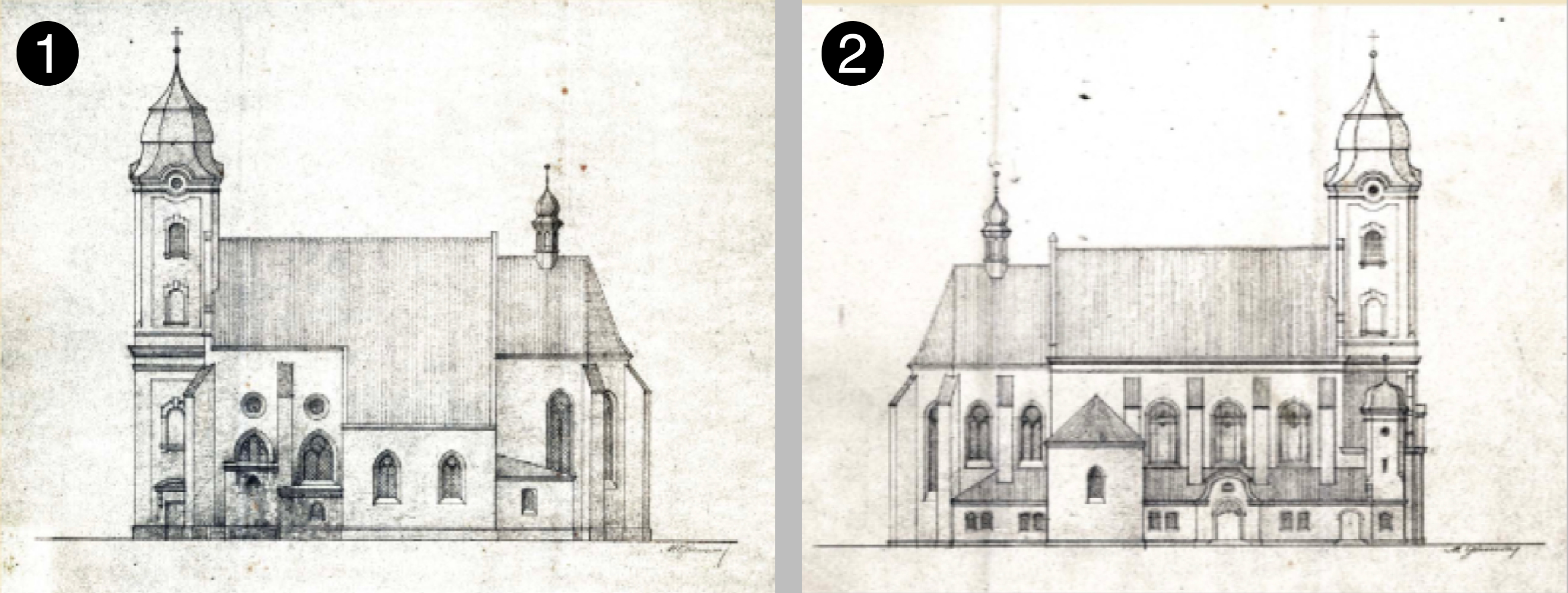
1. Church Appearance in 1914 before Planned but Unrealized Reconstruction
2. Proposal for Church Expansion and Neo-Baroque Modifications, Max Giemsa, 1914
Church Plan
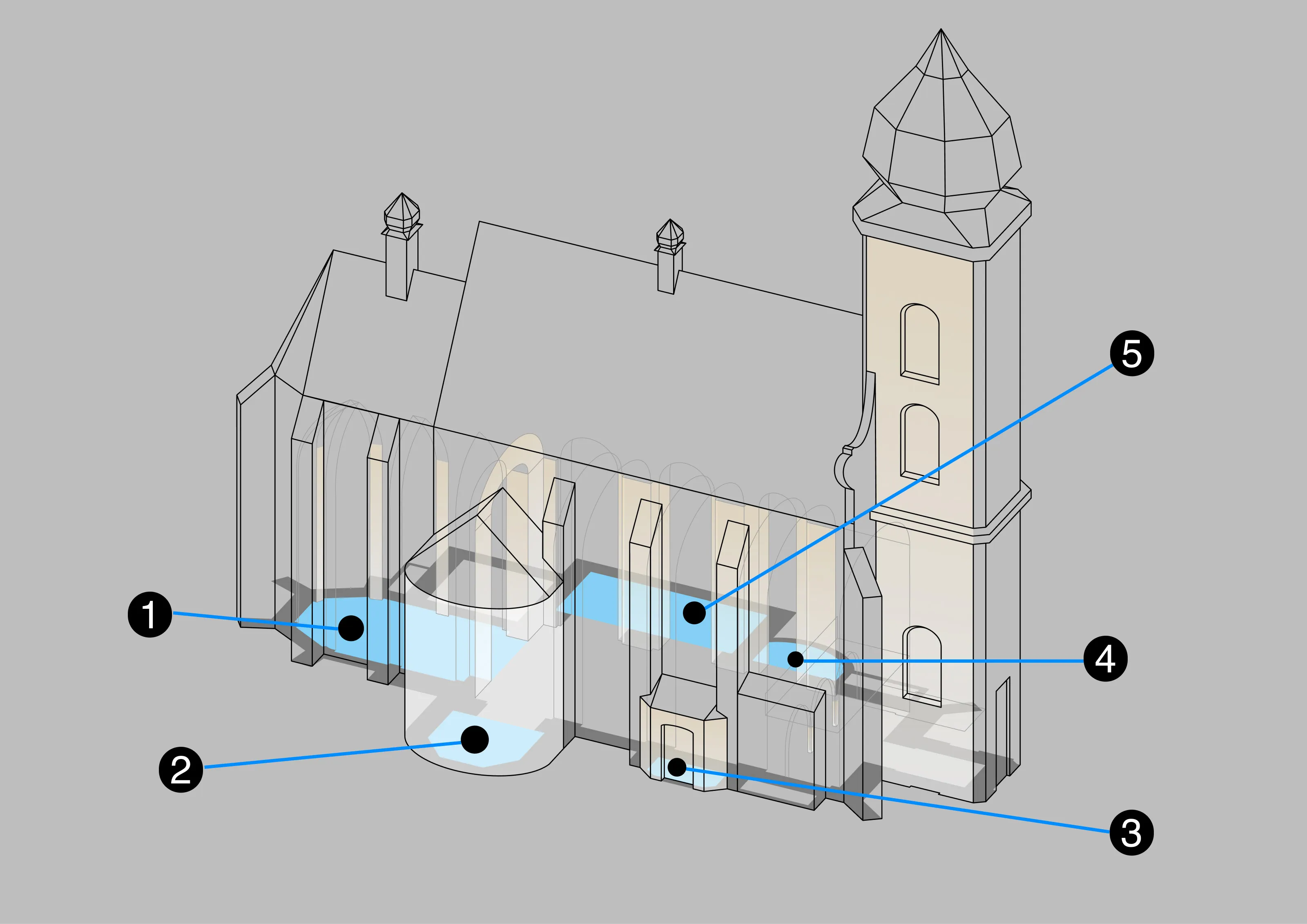
1 – Presbytery // 2 – Chapel of St. Anne // 3 – Original Chapel of Mary of Egypt // 4 – Chapel of Archangel Michael // 5 – Chapel of Angels (formerly Chapel of the Three Kings)