NAVE
Side Altars
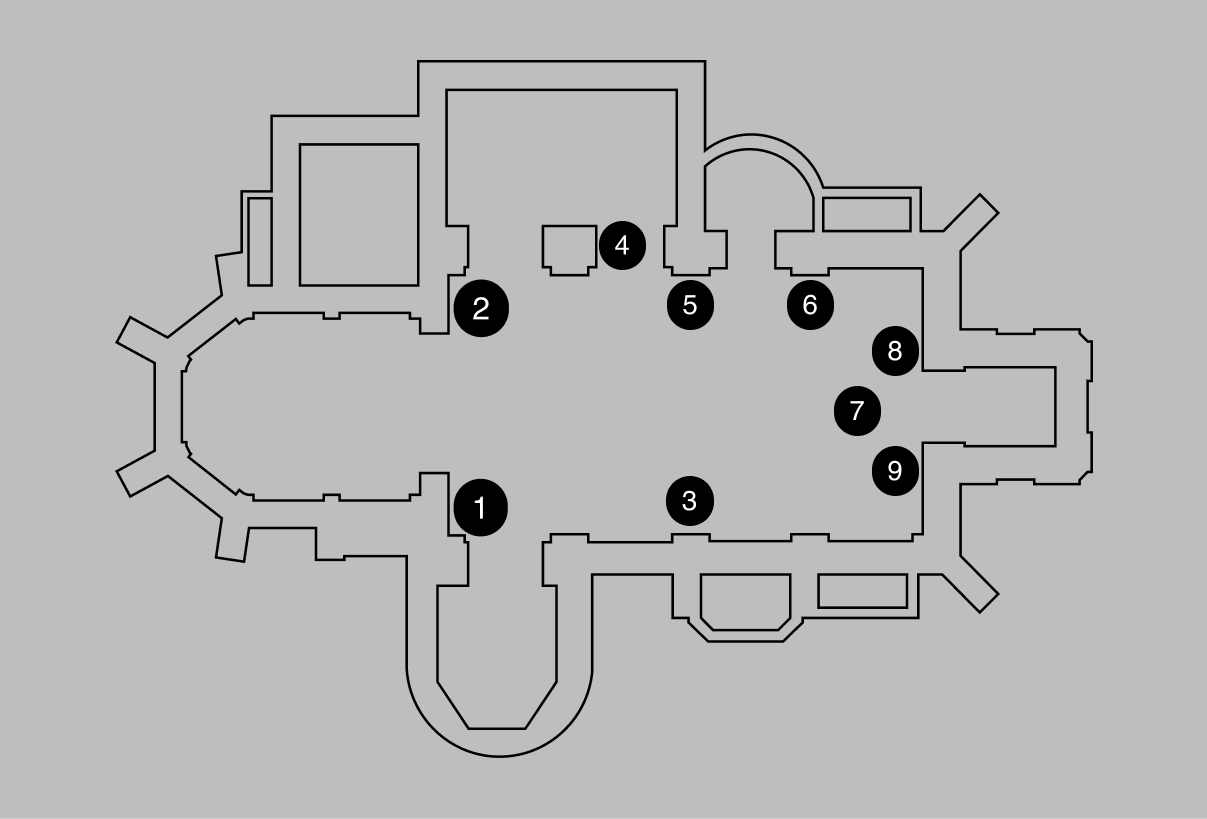
Side Altars of the Virgin Mary (1) and the Holy Cross (2)
Mayer’sche Hofkunstanstalt München – Wood – Late nineteenth century
Presumably around the turn of the 1880s and 1890s, a pair of Neo-Gothic altars was commissioned from the Mayer Art Studio in Munich (Mayer’sche Hofkunstanstalt München), which specialized in the production of ecclesiastical furnishings. These altars were positioned on either side of the triumphal arch. The architectural structure, enriched with numerous carved Gothic motifs such as finials, crockets, and tracery, incorporates a triad of sculptural figures. The Marian altar features the Virgin Mary as Protector, accompanied by the figures of St Aloysius Gonzaga and St Joseph. The opposite altar of the Holy Cross displays a Calvary—the Crucified Christ flanked by the Sorrowful Virgin and St John the Evangelist.
The Mayer Art Studio also supplied sculptures for the Altar of St Anne, as well as a pair of figures flanking the side altars: St Anthony of Padua and St Francis of Assisi, purchased in 1924.
Side Altars of St John of Nepomuk (3) and St Joseph (4)
Jan Bochenek – Oil on canvas – circa 1880
Rector Jáchym Richtarský (1830–1887; in office since 1872) was a friend and patron of two native sons of the town: the sculptor Jan Janda (1827–1895) and the painter Jan Bochenek (1831–1909). Around 1880, he commissioned from the painter a series of canvases for the Church of St Margaret (all of which perished in the church fire of April 1945) as well as for the parish Church of St John the Baptist. These works replaced the original, already damaged canvases on both the main and side altars. The side altars of St John of Nepomuk and St Joseph retain their Rococo frames, apparently dating from the 1780s. During the restoration, new canvases by Bochenek were installed in these frames, executed in the late Nazarene style.
Tombstones on the South Side of the Church Nave
Sandstone – 1530s
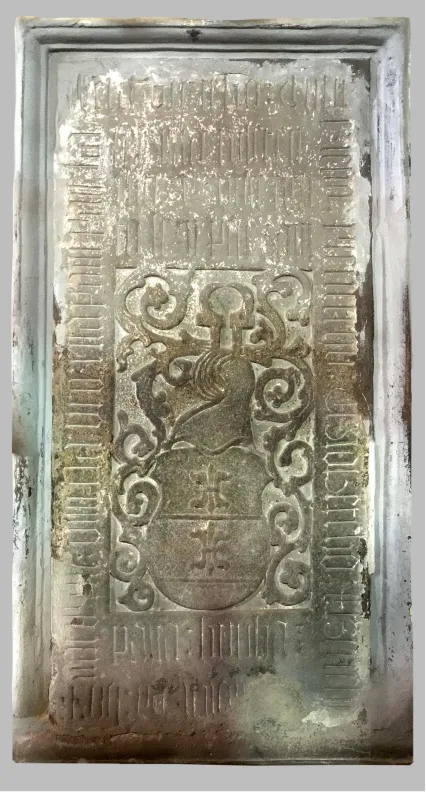
A pair of memorial slabs embedded in the wall on either side of the entrance to the Chapel of Archangel Michael represents the earliest in the ensemble of surviving Renaissance tombstones in the church. Both are fashioned from sandstone in the form of rectangular plaques bearing a family coat of arms in the center. Around the perimeter runs an inscription in Old Czech, carved in linear Gothic minuscule script. The identical design of both slabs suggests that they were executed simultaneously by a single workshop, commissioned by Bernard of Zvole, who wished to honor the memory of his second wife Margaret (died 1522) and his sister Catherine (died 1533). It was Catherine’s death that served as the impetus for commissioning both tombstones.
Tombstone of Margaret Zvolská from Starohlivice
Sandstone – 1530s
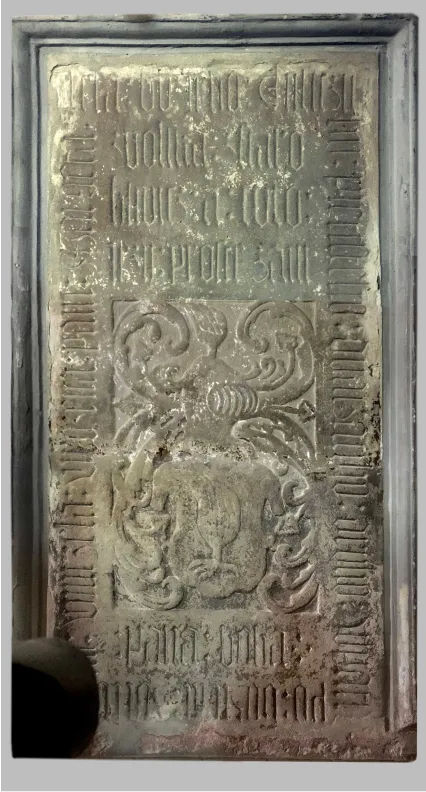
Margaret (died 1522) descended from the Návoj family of Starohlivice and became the second wife of Bernard of Zvole, owner of the Hlučín estate. The Návoj family bore in their coat of arms a bird’s claw, or talon, which also appears as a crest adorning the top of the helmet, complete with mantling. An inscription winds around the perimeter, reading:
n the year of our Lord one thousand five hundred twenty-second, on Friday after the Ascension, died the noble lady Margaret Zvolská of Starohlivice; here she rests. Pray for her to the Lord God.
Organ
Kánský-Brachtl – 2006
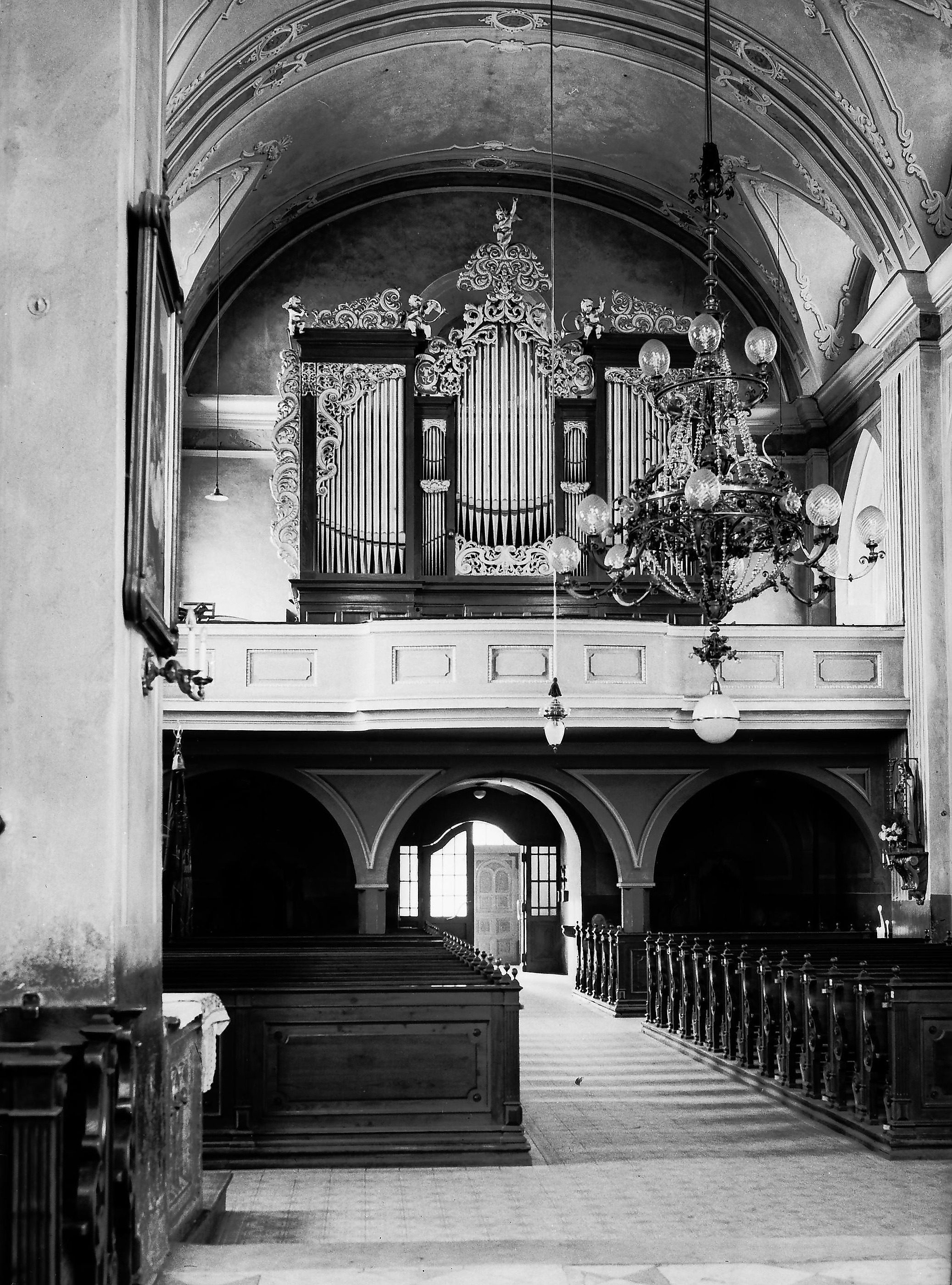
inancial donations of Count Jan Jiří Gaschin (died 1657), not only with new altars but also with Baroque pipe organs. Their case was adorned with numerous carved scrollwork and acanthus motifs, embellished with ribbons winding in profusion of spirals. The sculptural decoration was further enhanced by fruit garlands and a pair of coats of arms belonging to both donors—Count Jan Jiří Gaschin and his wife Anna Maria von Oppersdorf (1623–1663). These precious early Baroque organs have not survived. Their pipes were requisitioned together with the bells during the First World War. During the post-war restoration of the church, new organs were commissioned from the German organ builder Paul Berschdorf (1859–1933) of Nysa, which were consecrated in 1922. Berschdorf created an entirely new organ case, which was embellished with ornamental carvings from the old organs. However, both the composition of the case and its artistic design were not particularly successful. The poor technical condition of the instrument likewise called for restoration by the end of the millennium, but the parish and the town decided upon an entirely new instrument, which was constructed to correspond as faithfully as possible to the sound and tuning of Baroque organs (Kánský-Brachtl, 2006). The model for its artistic design was the organ case from the Church of the Transfiguration in Pezinok dating from 1662, thus approximately from the time when the original furnishings of the church in Hlučín were acquired.
Beneath the choir gallery parapet, on consoles, stand figures of St Hedwig of Silesia (8) and St Elizabeth of Thuringia (9). Like the other sculptural decoration of the church from the end of the nineteenth century, they originate from the Mayer Art Studio in Munich (Mayer’sche Hofkunstanstalt München) and originally stood on the Altar of St Anne in the side chapel.
 View toward the Choir Loft, Period Photograph, 1930s.